Fire Pumps & Standpipes
Engineered infrastructure to ensure reliable water supply and pressure for high-rise and large-scale industrial protection.
Request a Quote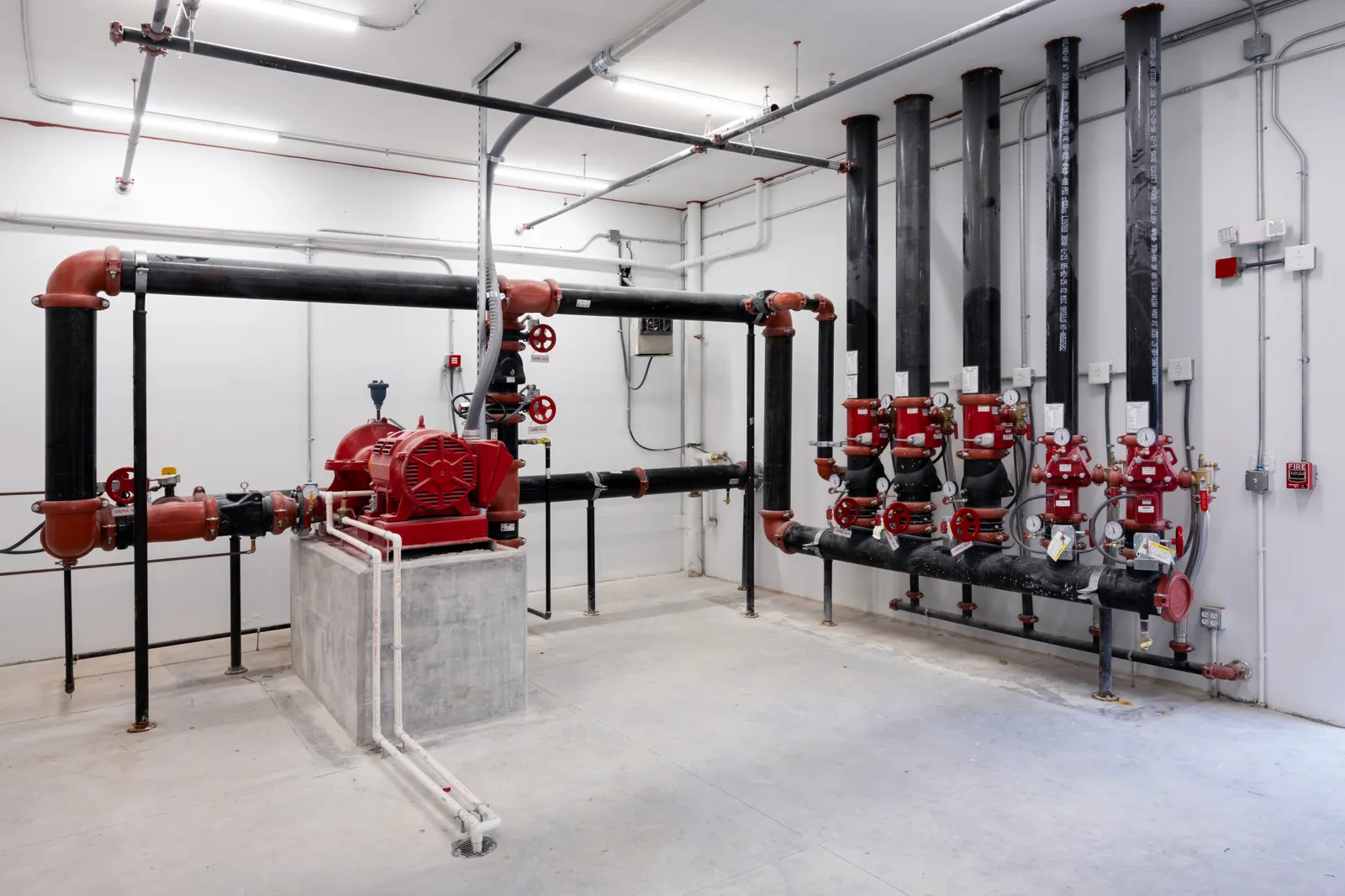
What are fire pumps & standpipes?
Fire pumps are the "heart" of a fire protection system, boosting water pressure and flow from the public utility or a private reservoir to meet the high demands of sprinkler and hose systems. They are critical when the local water supply lacks the natural pressure to reach the top floors of a building or the distal ends of a large facility.
Standpipes act as an internal hydrant network, delivering water to hose connections throughout a building. These systems allow fire departments to connect their hoses directly to a pressurized riser within the structure, saving precious time during emergency response in high-rise, mall, or large-area environments.
Systems & Configurations
Fire Pump Types
Horizontal Split-Case
The industrial standard for high-flow capacity; easy to maintain and inspect.
Vertical Turbine
Designed for sub-surface water sources where the pump is submerged in the supply.
Vertical In-Line
Compact, space-saving design suitable for smaller mechanical rooms and lower flow demands.
Electric & Diesel Drivers
Redundant power sources ensure operation during municipal grid failures.
Standpipe Classifications
Class I (Fire Department Use)
High-pressure 2.5" connections for professional fire service personnel.
Class II (Building Occupant Use)
1.5" hose stations intended for use by trained building staff prior to arrival of fire crews.
Class III (Hybrid Systems)
Combined 1.5" and 2.5" connections serving both occupants and first responders.
Wet vs. Dry Risers
Manual dry, semi-automatic, and automatic wet configurations based on climate and hazard.
Why it matters
Mechanical reliability is paramount. If a pump fails to start or a standpipe is obstructed, the entire active fire protection strategy of a building is compromised. Our design considerations focus on:
Available water supply and municipal pressure fluctuations. Building height and total square area hydraulic demands. Hose-stream demand for firefighting operations (NFPA 14). Backup power, fuel supply, and transfer switch reliability. Rigorous acceptance testing and churn/flow verification.
How Lacuna approaches it
Review
Detailed evaluation of water supply data and site-specific flow testing.
Calculate
Advanced hydraulic modeling to determine exact pump curve and power requirements.
Layout
Precision standpipe layout and riser coordination within stairwells and core spaces.
Coordinate
Proactive AHJ interface for pump room layout and fire department connection (FDC) approval.
Test
Construction phase support including flow test witnessing and certification support.
Applicable codes & standards
All pump and riser designs are subject to local Authority Having Jurisdiction (AHJ) review.
Applications
Secure your water supply with precision engineering.
Contact our mechanical fire protection experts for hydraulic analysis or design support.