CO2 Systems
High-concentration gaseous suppression for high-value industrial hazards and unoccupied special environments.
Request a Quote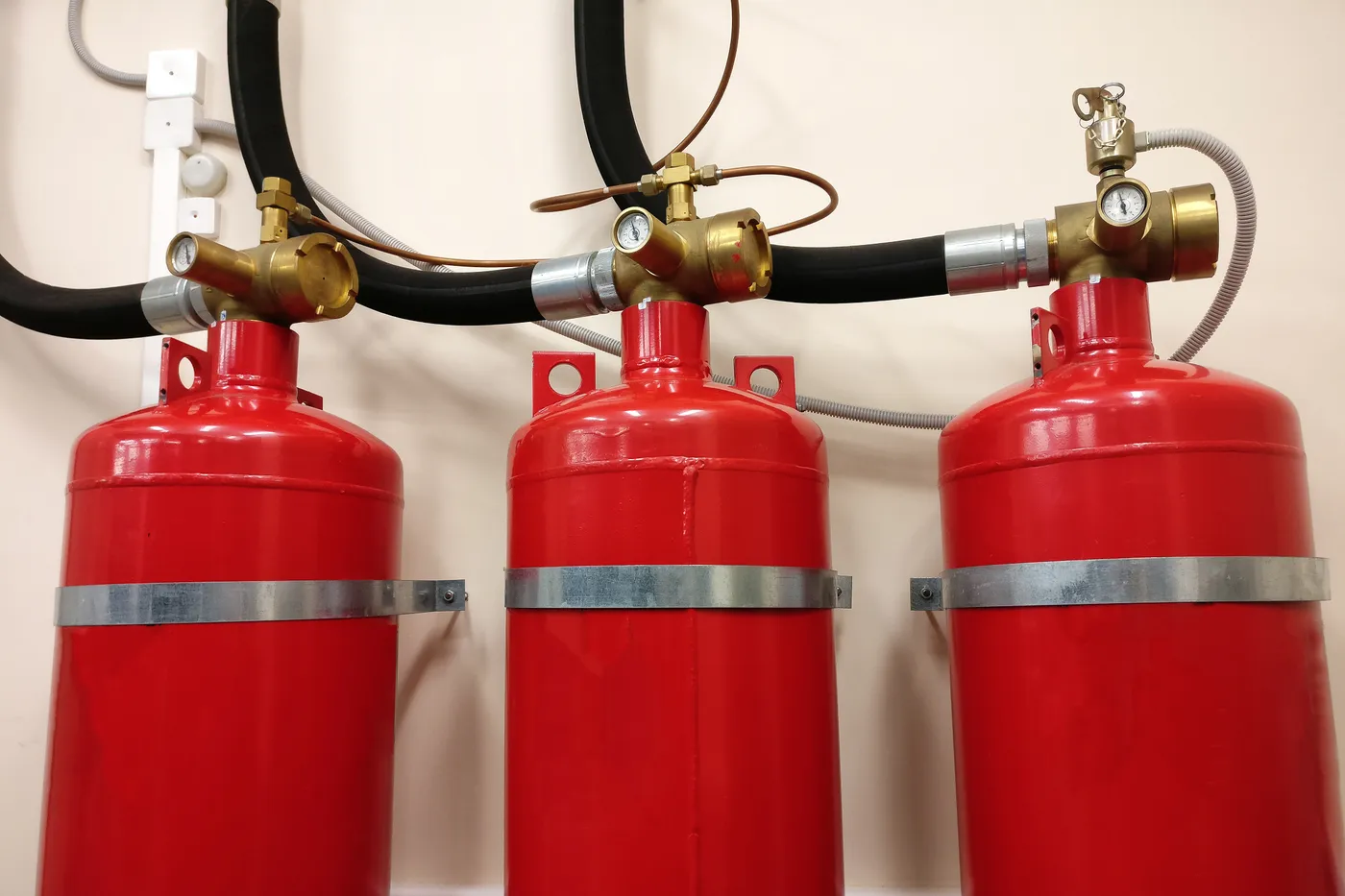
What is a CO2 system?
Carbon dioxide fire extinguishing systems work by flooding a volume or locally applying CO2 to a hazard to displace oxygen and smother fire. As a non-conductive, colorless, and odorless gas, CO2 leaves no residue, making it ideal for protecting sensitive industrial equipment.
Because carbon dioxide is an asphyxiant at the concentrations required for fire suppression, these systems are specifically designed for unoccupied spaces or hazards with stringent personnel safety safeguards and lockout protocols.
Types of CO2 Systems
High-Pressure Storage
CO2 stored in individual cylinders at ambient temperature; suitable for smaller or localized hazards.
Low-Pressure Storage
Large refrigerated tanks for bulk storage; efficient for high-volume flooding requirements.
Total Flooding
Discharges gas into a sealed enclosure to reach a design concentration throughout the volume.
Local Application
Nozzles directed specifically at a high-risk piece of equipment in an open space.
Why it matters
Safety is the primary driver in CO2 system engineering. Because the agent is lethal at extinguishing concentrations, we integrate critical life-safety layers:
Pneumatic time delays and pre-discharge alarms to ensure evacuation. Wintergreen odorizers to provide a distinct warning of gas presence. Physical lockout valves for safe maintenance and personnel entry. Strict OSHA compliance for signage, training, and respiratory protocols. Rapid response for electrical and high-heat process hazards.
How Lacuna approaches it
Review
Rigorous hazard assessment and occupancy/egress path analysis.
Design
Precise concentration calculations and nozzle placement for uniform coverage.
Safety
Integration of mechanical and electrical safety interlocks and warning systems.
Coordinate
Direct AHJ liaison to ensure understanding of safety sequencing.
Support
Field verification of pipe integrity and discharge testing coordination.
Applicable codes & standards
Lacuna prioritizes life-safety protocols above all design criteria.
Where it's used
Secure your high-hazard process assets.
Expert gaseous suppression design for specialized industrial environments.