Clean Agent (Gaseous)
Waterless fire suppression designed to protect critical infrastructure, sensitive electronics, and high-value assets without residue or business interruption.
Request a Quote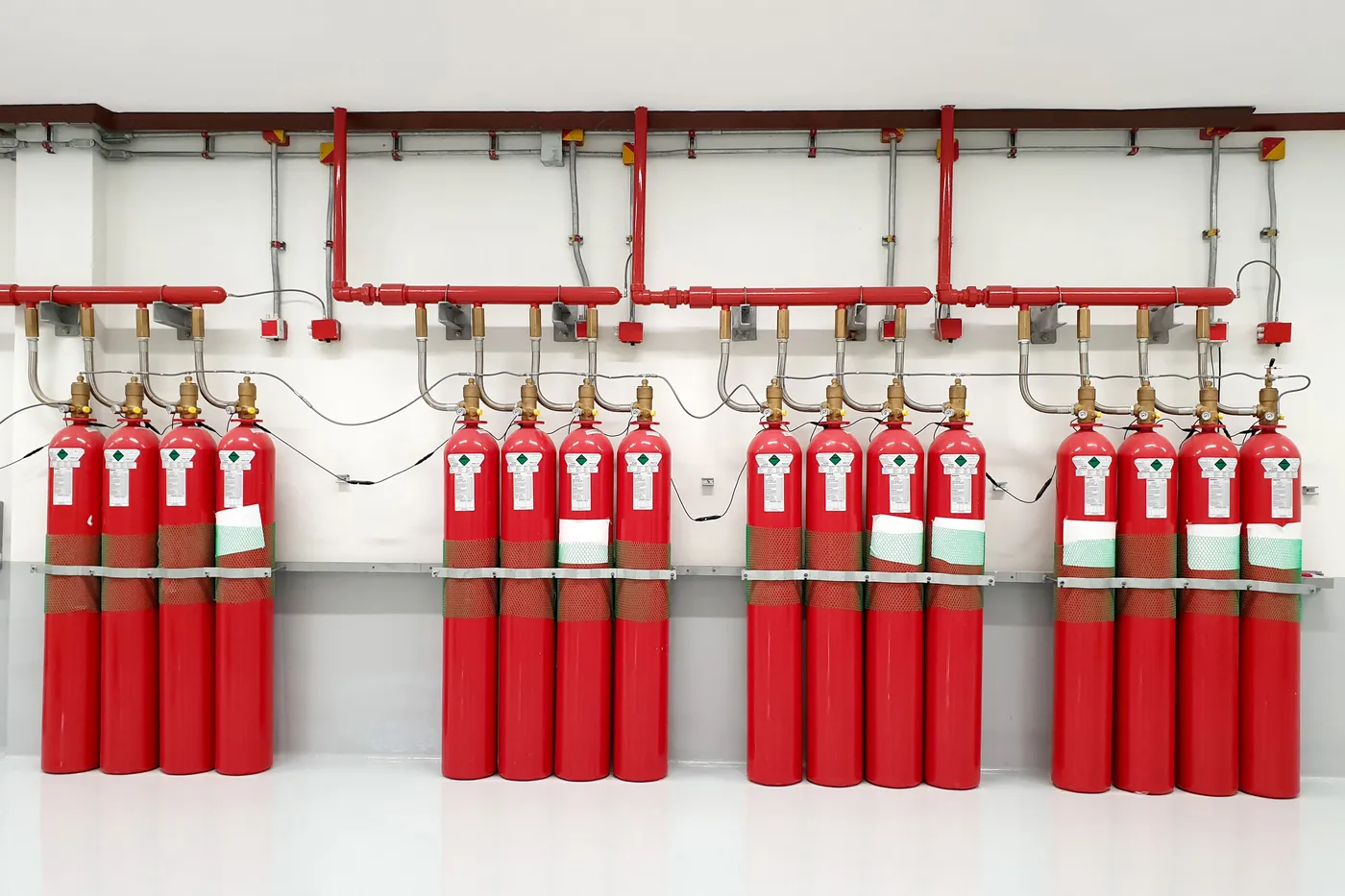
What is a clean agent system?
A clean agent fire suppression system utilizes an electrically non-conductive, volatile, or gaseous fire extinguishant that does not leave a residue upon evaporation. The system involves a stored gaseous agent that floods a sealed space to suppress fire by either removing heat or disrupting the combustion cycle at a molecular level.
These systems are critical for protecting contents that water would ruin—such as telecommunications equipment, archival documents, and industrial control systems—enabling rapid restoration of operations with zero cleanup requirements after a discharge event.
Agent Classifications
Halocarbon Agents
Chemical agents including FK-5-1-12 (Novec 1230) and HFC-227ea (FM-200). These suppress fire primarily through heat absorption and are stored as liquids that vaporize upon discharge.
Inert Gas Systems
Natural atmospheric gases such as IG-541 (Inergen), IG-55 (Argonite), and IG-100 (Nitrogen). These suppress fire by reducing the oxygen concentration below the level that supports combustion while remaining safe for occupants.
Total Flooding
Design methodology that involves discharging the agent throughout the entire enclosed volume to achieve a uniform extinguishing concentration.
Local Application
Targeted discharge directly onto a specific hazard within a larger space, used where enclosure integrity is not feasible.
Critical Design Considerations
Unlike water-based systems, clean agents require absolute precision in volume and containment. Our engineering focus includes:
Irreplaceable/Sensitive Contents: Safeguarding electronics and historical artifacts. Enclosure Integrity: Ensuring the room can hold the agent during the soak period. Concentration & Hold Time: Precise hydraulic design for effective suppression. Occupant Safety & Egress: Managing discharge visibility and oxygen levels. System Interlocks: Coordination with HVAC, dampers, and power-downs.
How Lacuna approaches it
Hazard Review
In-depth review of the space, fuel load, and specific equipment sensitivity.
Selection
Selection of optimal chemical or inert agent and concentration design.
Testing
Coordination of door-fan integrity testing to verify room enclosure.
Submission
Proactive AHJ coordination and detailed submittal packages.
Construction
On-site support during installation and final acceptance testing.
Codes & Regulatory Standards
All designs are coordinated with the local Authority Having Jurisdiction (AHJ).
Common Applications
Protect your mission-critical infrastructure.
Consult with our special hazard experts to design a system tailored to your risk profile.